
Starting a business in Nepal is exciting. But before you open your doors and welcome customers, there is one very important step you must not skip: local business registration.
Think of local business registration like getting a permission slip from the government. It tells the world that your business is real, legal, and trustworthy. Without it, your business has no legal identity. That means you cannot open a business bank account, you cannot bid for government contracts, and you cannot attract serious investors.
Whether you run a small tea shop, a software startup, or a trading company, local business registration in Nepal is not optional. It is the first and most important thing you need to do. This guide walks you through everything step by step ; from understanding what local business registration means to completing the full Nepal business registration process.
By the end of this blog, you will know exactly how to register your business, which documents to prepare, which government offices to visit, and how to avoid common mistakes that slow people down.
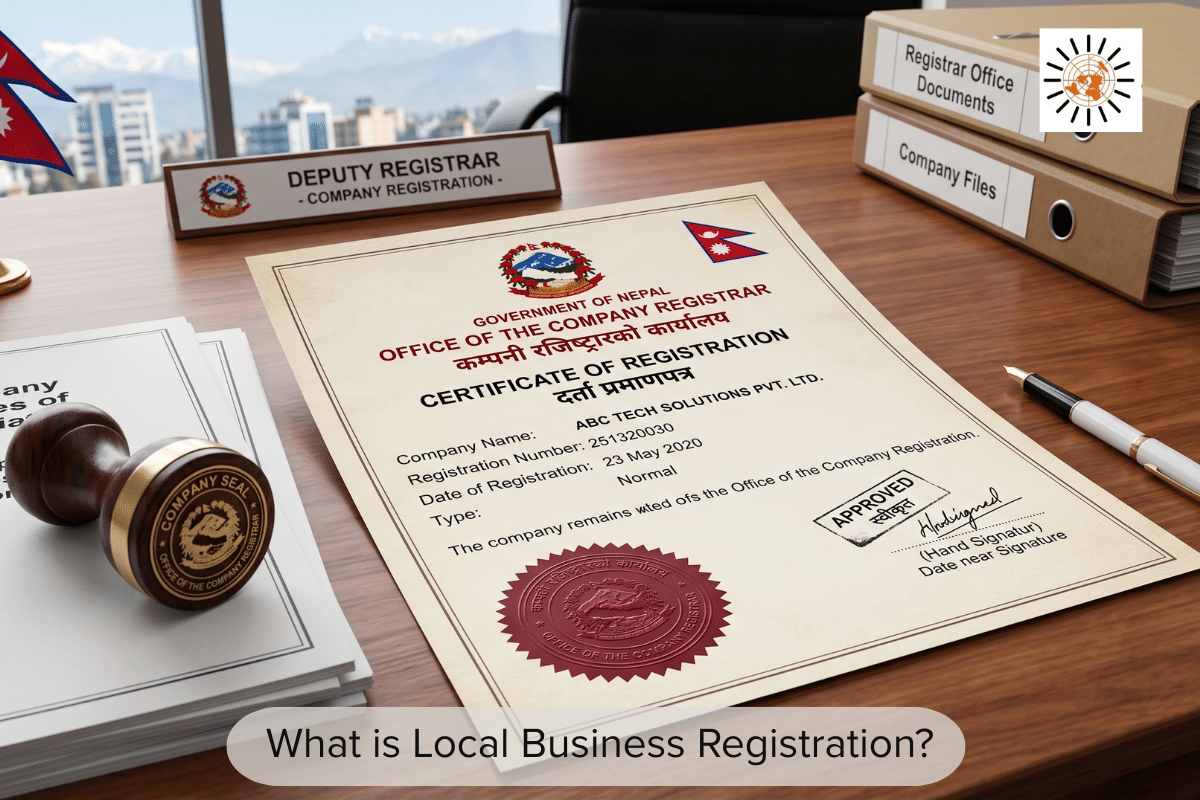
What is Local Business Registration?
Local business registration is the official process of making your business legal in the eyes of the government. When you complete local business registration, your business gets a unique identity ; a registration number, a legal name, and official recognition.
In simple terms, it is like getting a birth certificate for your business. Just as a person needs a birth certificate to prove they exist, a business needs registration to prove it is real and operating legally.
Local Business registration Nepal covers all types of businesses ; big or small. This includes:
-
Solo traders and freelancers running a one-person business
-
Startups launching new products or services
-
Small and medium enterprises (SMEs) serving local communities
-
Local enterprises like shops, restaurants, and service providers
Company registration in Nepal is handled by the Office of Company Registrar under the Government of Nepal. Depending on your business type, you may also need to register with local ward offices or industry departments.
Why Business Registration Matters in Nepal
Some people think they can skip local business registration in Nepal and just start working. That is a big mistake. Here is why proper local business registration is so important:
1. Legal Recognition
Once you complete local business registration, your business becomes a legal entity. This means it is protected by the laws of Nepal. If someone cheats you or refuses to pay, you can take legal action. Without registration, you have almost no legal protection.
2. Tax Compliance
Local Business registration in Nepal automatically connects your business to the tax system through PAN (Permanent Account Number) registration. Being tax-compliant protects you from heavy fines and legal trouble with the Inland Revenue Department.
3. Access to Banking
Banks in Nepal will not open a business account for an unregistered company. After completing local business registration, you can open a proper business bank account, apply for loans, and manage your finances professionally.
4. Investment Opportunities
Investors ; whether local or foreign ; only put money into registered businesses. A local business registration certificate is one of the first things an investor will ask to see. Without it, you cannot raise funding.
5. Government Tenders
If you want to work with the government, supply goods, or offer services under government contracts, you must have completed your local business registration. Unregistered businesses are not eligible to apply.
6. Business Credibility
Customers, suppliers, and partners trust registered businesses more. When people see your business registration certificate displayed, they feel confident doing business with you. It shows you are serious and professional.
Types of Business Structures in Nepal
Before you begin the company registration process in Nepal, you need to choose the right business structure. This is one of the most important decisions you will make. The structure you choose will affect your taxes, your legal responsibility, and how your business grows.
Here are the main types of business registration in Nepal:
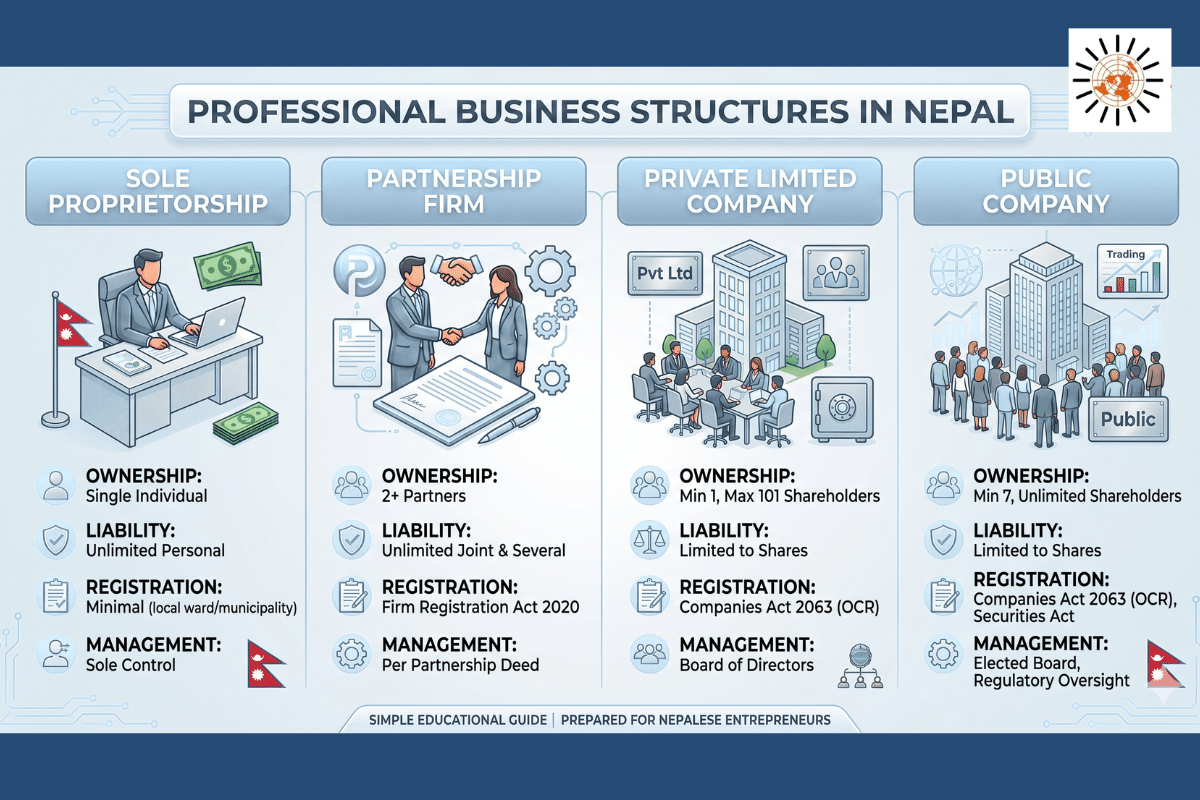
1. Sole Proprietorship
A sole proprietorship is the simplest form of local business registration in Nepal. One person owns and runs the entire business. It is ideal for small shops, freelancers, and individual traders.
-
Easy and affordable to register
-
Owner has full control
-
Owner is personally responsible for all debts
-
Best for very small businesses and self-employed individuals
2. Partnership Firm
A partnership firm is owned by two or more people who share profits and responsibilities. It is a common choice for small businesses where two friends or family members want to work together.
-
Shared investment and responsibility
-
Requires a partnership deed
-
All partners are personally liable for business debts
-
Good for medium-sized local enterprises
3. Private Limited Company
A private limited company is the most popular choice for serious businesses and startups in Nepal. It is a separate legal entity from its owners. This means the company can own assets, sign contracts, and take legal action in its own name.
-
Minimum 1 shareholder, maximum 101 shareholders
-
Limited liability ; owners are not personally responsible for company debts
-
More professional and attractive to investors
-
Requires company registration with the Office of Company Registrar
4. Public Company
A public company can sell its shares to the general public. It is suitable for large businesses that want to raise significant capital. Public companies in Nepal must follow strict rules from the Securities Board of Nepal (SEBON).
-
Can list shares on the Nepal Stock Exchange (NEPSE)
-
Requires a minimum of 7 shareholders
-
Subject to strict regulatory compliance
-
Best for large-scale businesses
5. Branch Office / Foreign Investment Entity
Foreign companies that want to operate in Nepal can set up a branch office or a joint venture with a Nepali partner. These require special approval from the Department of Industry and the Investment Board of Nepal.
How to Register a Local Business in Nepal: Step-by-Step Process
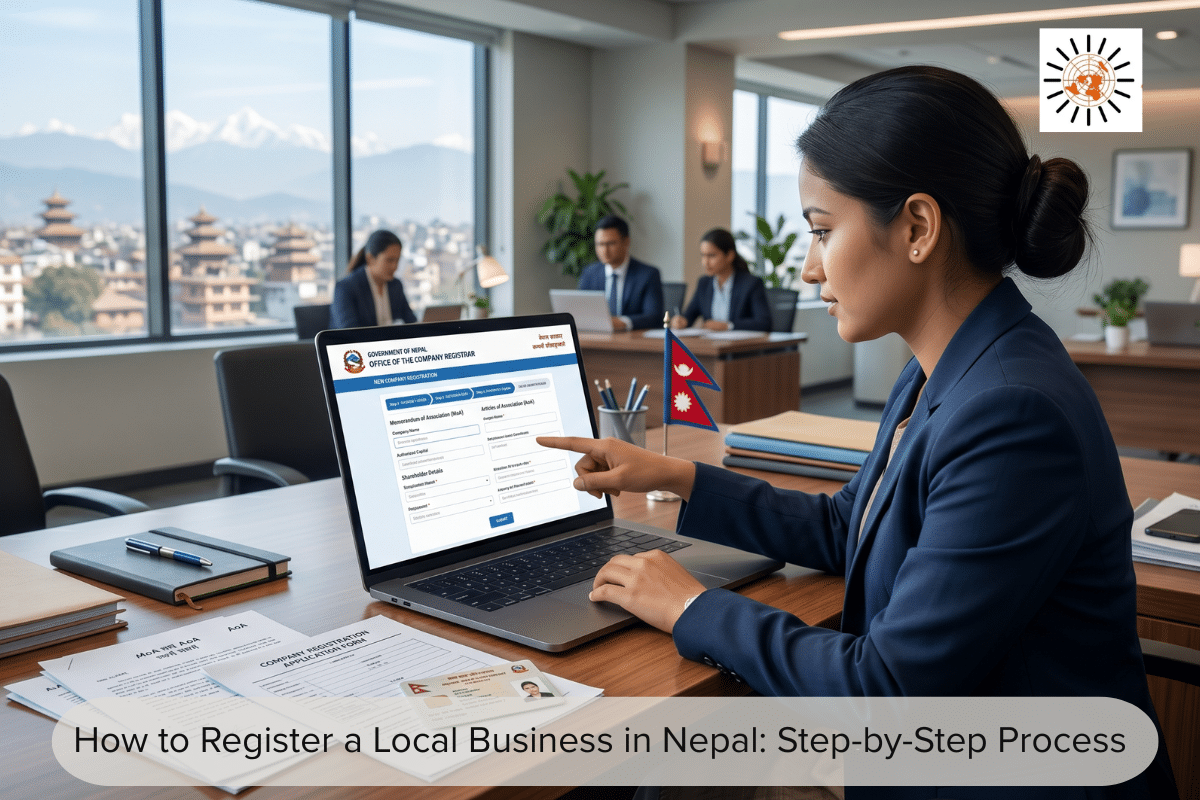
Now let us look at the actual Nepal local business registration process. Follow these steps carefully. Skipping any step can delay your registration and create legal problems later.
Step 1: Choose the Right Business Structure
The first step in any company registration process in Nepal is deciding what type of business you want to form. Use the information in the section above to pick the structure that fits your needs. If you are not sure, a legal expert can help you decide.
Step 2: Company Name Registration
You need to choose a unique name for your business. The name must not be the same as any existing registered company. During company name registration, you will check name availability on the OCR portal and formally reserve your business name.
-
Keep the name simple and easy to remember
-
Avoid names that are too similar to existing businesses
-
The name should reflect what your business does
Step 3: Prepare Required Legal Documents
Before submitting any application, gather all necessary documents. These typically include citizenship certificates, photographs, Memorandum of Association, Articles of Association, and address proof. See the full document list in the section below.
Step 4: Submit Application to the Office of Company Registrar
The Office of Company Registrar (OCR) is the main body that handles company registration in Nepal. You will submit your documents here ; either in person or through their online portal. The registrar of companies will review your application and issue approval.
Step 5: Obtain PAN Registration
After company registration, you must register for PAN (Permanent Account Number) with the Inland Revenue Department. PAN registration is mandatory for all businesses in Nepal. It is used for all tax-related activities.
Step 6: Complete Local Business Licensing Requirements
Depending on your business type and location, you may need additional licenses. Local business registration and licensing can include ward-level permits, industry-specific licenses, and municipality approvals. For example, a restaurant needs a food license; a pharmacy needs a drug registration.
Step 7: Obtain Your Business Registration Certificate
Once all steps are completed and approved, you will receive your official business registration certificate. This document is proof that your local business registration is complete and your business is legally operating in Nepal. Keep it safe ; you will need it for banking, contracts, and more.
Required Documents for Local Business Registration in Nepal
Having the right documents ready before you start saves you a lot of time. Here is a complete list of documents commonly required for local business registration in Nepal:
| Document | Purpose |
| Citizenship Certificate (Copy) | Identity verification for business owners |
| Passport-size Photos | Applicant records and identification |
| Rental Agreement / Land Ownership Proof | Business address verification |
| Memorandum of Association (MOA) | Official document defining company purpose and structure |
| Articles of Association (AOA) | Rules for internal company governance |
| PAN Documents | Tax registration with the Inland Revenue Department |
| Company Name Approval Letter | Proof of approved company name registration |
| Board Resolution (for companies) | Authorization for company registration activities |
If you are registering as a foreign investor or branch office, additional documents such as a notarized company profile and board resolution from the parent company will be required.
Which Government Authorities Handle Business Registration?
Many first-time business owners are confused about which office to visit for local business registration. Here is a simple breakdown:
1. Office of Company Registrar (OCR)
The Office of Company Registrar is the primary government body for company registration in Nepal. It handles registration of private limited companies, public companies, and foreign branch offices. Visit: ocr.gov.np
2. Inland Revenue Department (IRD)
After completing your basic company registration in Nepal, you must visit the Inland Revenue Department to get your PAN number and register for VAT if your annual turnover exceeds the government threshold.
3. Local Ward / Municipality Office
For local business registration at the grassroots level, your local ward office plays a key role. They issue ward-level business operating permits, especially for small shops and service businesses operating within a specific locality.
4. Cottage and Small Industry Office
If you are running a cottage industry, manufacturing unit, or small industry, you need to register with the Department of Cottage and Small Industry. This is especially important for artisans, handicraft makers, and small-scale producers.
Online Company Registration in Nepal
Good news ; the government of Nepal has been working to make online company registration easier and more accessible. Here is what you need to know about online business registration in Nepal:
The Office of Company Registrar has launched an online portal where business owners can start the small business registration online process. Through this portal, you can:
-
Check your company name availability
-
Fill and submit registration forms digitally
-
Upload required documents online
-
Track the status of your application
However, online company registration in Nepal still has some limitations. Physical presence may still be required for document verification, signature authentication, and collecting the final local business registration certificate. The system is improving, but it is not yet 100% digital for all business types.
For small business registration online, it is advisable to work with a legal professional who knows the system well. This avoids errors in your application that could cause delays.
Business Registration Certificate and Verification Process
The business registration certificate is the most important document your business will ever receive. It is the official proof that your local business registration is complete and your business is operating legally in Nepal.
What Does the Certificate Include?
-
Official business name
-
Registration number
-
Business type and structure
-
Date of registration
-
Name of the registrar
Business Registration Check
You can do a business registration check online through the OCR portal or IRD portal. This is useful when you want to verify a supplier, partner, or client’s business legitimacy before doing business with them.
Renewal Obligations
Your business registration certificate must be renewed annually. Failure to renew on time results in penalties and may even lead to cancellation of registration. Mark your renewal dates on the calendar every year.
Common Mistakes During Company Registration
Many businesses face delays and rejections during local business registration because of avoidable errors. Here are the most common mistakes to watch out for:
1. Choosing the Wrong Business Structure
Many people rush into local business registration without thinking about the right structure. Choosing sole proprietorship when you need a private limited company ; or vice versa ; can cause legal and tax complications down the line.
2. Incorrect Documentation
Submitting incomplete, outdated, or incorrect documents is the top reason for registration delays. Always double-check every document before submission.
3. Improper Company Objectives
The Memorandum of Association must clearly state what your business does. Vague or overly broad objectives can result in rejection or future legal problems.
4. Ignoring Tax Obligations
Many newly registered businesses delay PAN registration and VAT registration. This leads to penalties from the Inland Revenue Department. Complete your tax registration immediately after company registration.
5. Delayed Renewals
Letting your business registration certificate expire is a common and costly mistake. Renewal fees increase with delay, and in serious cases, your registration can be cancelled.
What Is the Minimum Capital Required to Open a Company in Nepal?
This is one of the most frequently asked questions about local business registration in Nepal. The answer depends on the type of business:
-
Sole Proprietorship: No minimum capital requirement
-
Partnership Firm: No fixed minimum, agreed by partners
-
Private Limited Company: Minimum paid-up capital of NPR 1,00,000 (One Lakh)
-
Public Company: Minimum paid-up capital of NPR 1,00,00,000 (One Crore)
-
Foreign Investment (Joint Venture): Minimum foreign equity of USD 50,000
These figures are based on current regulations and may be updated by the government. For the most accurate and current capital requirements, especially for foreign investment considerations, consult a legal expert before starting your company registration process in Nepal.
Legal Framework Governing Business Registration in Nepal
Most blogs about local business registration in Nepal skip this part. But knowing the legal framework is very important. These are the actual laws that control how businesses are registered, operated, and regulated in Nepal. Understanding them gives your business a strong legal foundation from day one.
Here are the key laws that every business owner should be aware of before starting the company registration process in Nepal:
1. Companies Act, 2063 (2006)
This is the main law governing company registration in Nepal. The Companies Act, 2063 sets out the rules for forming, operating, and dissolving private limited companies and public companies. It defines what a company is, how many shareholders are required, what documents are needed, and how the company must be governed.
Every private limited company and public company registered in Nepal must comply with the Companies Act, 2063. The Office of Company Registrar uses this act as the primary legal guide when reviewing your local business registration application.
2. Industrial Enterprises Act, 2076 (2020)
The Industrial Enterprises Act, 2076 governs businesses involved in production, manufacturing, and industrial activities. If you are starting a factory, a processing unit, or any production-based business, this act is directly relevant to your local business registration.
This act classifies industries into different categories ; micro, cottage, small, medium, and large ; and sets out the registration process and compliance requirements for each. It also provides various incentives and protections for local industries in Nepal.
3. Foreign Investment and Technology Transfer Act (FITTA), 2075 (2019)
If you are a foreign investor or a Nepali entrepreneur seeking foreign funding, the Foreign Investment and Technology Transfer Act is the law that controls your business registration in Nepal. FITTA defines which sectors are open to foreign investment, the minimum investment amount, profit repatriation rules, and the approval process.
Under FITTA, foreign investors must obtain approval from the Department of Industry or the Investment Board of Nepal before completing company registration in Nepal. Any business involving foreign capital must follow FITTA regulations throughout its operational life.
4. Inland Revenue Act and Tax Laws
Once your local business registration is complete, you become subject to Nepal’s tax laws. The Inland Revenue Act governs how businesses pay income tax, VAT (Value Added Tax), and other levies. All registered businesses must obtain a PAN (Permanent Account Number) from the Inland Revenue Department as part of the Nepal business registration process.
Businesses with annual turnover above NPR 50 lakhs (for goods) or NPR 20 lakhs (for services) must also register for VAT. Failing to comply with the Inland Revenue Act can result in heavy fines and legal action against your business.
5. Local Government Operation Act, 2074 (2017)
The Local Government Operation Act, 2074 gives Ward Offices and Municipalities the authority to issue local business operating permits. This means that for your local business registration to be fully complete, you also need to comply with the rules set by your local government ; not just the central government.
This act is especially important for small shops, restaurants, service businesses, and any enterprise that operates within a specific ward or municipality. Ward offices can issue, suspend, or cancel local operating licenses under this act.
Important: Compliance with all of the above laws is not optional. Violating any of these acts during or after your local business registration can result in fines, suspension of business activities, or even criminal liability. If you are unsure about which laws apply to your specific business, it is strongly recommended to consult a qualified law firm in Nepal before proceeding.
Sole Proprietorship vs Private Limited Company in Nepal
One of the most common questions people ask when starting the local business registration process is: should I register as a sole proprietorship or a private limited company? These are the two most popular choices for small and medium businesses in Nepal.
The answer depends on your goals, your risk appetite, and how big you want to grow. Here is a simple side-by-side comparison to help you decide:
| Factor | Sole Proprietorship | Private Limited Company |
| Ownership | Single person only | 1 to 101 shareholders |
| Liability | Unlimited – owner is personally responsible for all business debts | Limited – owners only lose what they invested |
| Registration Cost | Lower – simpler process | Higher – more documents and fees |
| Access to Funding | Harder – banks and investors are cautious | Easier – more credible for loans and investment |
| Tax Treatment | Income taxed as personal income | Taxed as a separate legal entity |
| Business Continuity | Ends if owner retires or passes away | Continues independently of owners |
| Compliance Requirements | Minimal annual filings | Stricter – annual audits and filings required |
| Best For | Freelancers, small shops, solo traders | Startups, growing businesses, investor-backed ventures |
| Legal Identity | Not separate from the owner | Fully separate legal entity |
| Decision Making | Fast – owner decides everything alone | Requires board decisions for major actions |
If you are just starting out and want to keep things simple and low-cost, sole proprietorship local business registration may be the right choice. However, if you plan to grow, bring in partners, or raise investment in the future, registering a private limited company from the start is the smarter long-term decision.
Still not sure which structure fits your goals? A legal expert can review your business plan and help you choose the right type of company registration in Nepal before you take any official steps.
How Much Does Business Registration Cost in Nepal?
This is a question almost every entrepreneur asks before starting their local business registration. The honest answer is: it depends. The total cost of business registration in Nepal varies based on your business structure, the government fees at the time of application, and whether you hire legal help.
Let us break it down into three main cost categories so you have a clear picture:
1. Government Fees
Government fees for company registration in Nepal are set by the Office of Company Registrar and the Inland Revenue Department. These fees change periodically, so always check the latest rates on the official OCR portal before applying. Here is a general estimate of what to expect:
| Business Type | Estimated OCR Fee | PAN / IRD Fee |
| Sole Proprietorship | NPR 500 – 1,500 (ward level) | Free (PAN registration) |
| Partnership Firm | NPR 1,000 – 3,000 | Free (PAN registration) |
| Private Limited Company | NPR 5,000 – 15,000+ (based on capital) | Free (PAN registration) |
| Public Company | NPR 20,000+ | Free (PAN registration) |
| Branch Office (Foreign) | NPR 25,000 – 50,000+ | Free (PAN registration) |
Note: These are approximate figures. OCR fees for private limited companies are calculated on a sliding scale based on your declared paid-up capital. Higher capital means higher registration fees.
2. Legal and Professional Fees
Most business owners in Nepal choose to hire a lawyer or a legal firm to handle their local business registration. This is especially true for private limited companies where the documentation ; Memorandum of Association, Articles of Association, and compliance filings ; can be complex.
Legal fees for company registration in Nepal typically range from NPR 10,000 to NPR 50,000 or more, depending on the complexity of the registration and the law firm you choose. While this is an added cost, it saves you significant time, prevents costly errors, and ensures your registration is done correctly the first time.
3. Licensing Fees
Depending on your business type and location, you may need additional licenses after completing your basic local business registration. These come with their own fees:
-
Ward-level business operating permit: NPR 500 – 5,000 (varies by municipality)
-
VAT registration: Free, but requires annual compliance filings
-
Industry-specific licenses (food, pharmacy, construction, etc.): NPR 2,000 – 20,000+ depending on the sector
-
Import/export license (if applicable): Separate fees apply
4. Structure-Based Cost Differences
The overall cost of local business registration in Nepal is directly tied to your chosen business structure. A sole proprietorship is the cheapest and fastest to register. A private limited company costs more due to higher government fees, more complex documentation, and mandatory professional involvement.
Here is a simple way to think about it: for a sole proprietorship, total costs including all fees and basic legal help can range from NPR 3,000 to NPR 10,000. For a private limited company, expect to spend NPR 30,000 to NPR 80,000 or more when you add up government fees, legal charges, and initial compliance costs.
Always budget for these costs before starting your Nepal business registration process. Trying to cut corners on legal fees often leads to mistakes that cost much more to fix later.
Why Choose Eurasian Law Associates for Company Registration Assistance?
Navigating the local business registration process in Nepal can feel overwhelming ; especially if this is your first time. There are multiple offices, several documents, and various legal requirements to handle. One wrong step can cost you weeks of delay.
That is where Eurasian Law Associates comes in. As a trusted law firm in Nepal, Eurasian Law Associates helps businesses of all sizes complete their business registration in Nepal smoothly, quickly, and correctly.
Here is what they help with:
-
Legal documentation preparation ; MOA, AOA, and all registration forms
-
Company incorporation support from start to finish
-
PAN registration and tax compliance guidance
-
Business registration and licensing across all required government offices
-
Post-registration legal support including annual renewal and compliance monitoring
Eurasian Law Associates helps businesses navigate local business registration and legal compliance requirements in Nepal. Whether you are a Nepali entrepreneur or a foreign investor, their team will make sure your company registration in Nepal is done right the first time.
Contact Eurasian Law Associates today for a free consultation on your local business registration needs.
Conclusion
Local business registration is not just a legal formality. It is the foundation of every successful business in Nepal. Without it, your business cannot grow, cannot get a bank account, and cannot gain the trust of customers and partners.
Whether you are starting a small shop in your neighborhood or launching a tech startup in Kathmandu, completing your business registration; Nepal is the most important first step you can take. The company registration process in Nepal has become easier with online options, but it still requires careful preparation and the right guidance.
From choosing the right business structure to understanding the legal framework ; Companies Act, 2063, FITTA, the Inland Revenue Act, and the Local Government Operation Act ; every detail of your local business registration matters. Understand the costs upfront, compare your structure options, and prepare your documents carefully.
If you want to make the entire local business registration process smooth and stress-free, Eurasian Law Associates is here to help. Their experienced team of legal professionals will guide you through every step of the company registration in Nepal ; from the very first document to post-registration compliance.
Frequently Asked Questions (FAQs)
1. How do I register a local business in Nepal?
To complete local business registration in Nepal, first choose your business type. Then select a business name, prepare your documents, and apply through the proper government office. After approval, you also need tax registration and any required licenses.
2. What is the process for company registration in Nepal?
The company registration process in Nepal usually starts with choosing a business structure and reserving a company name. After that, you submit documents to the relevant authority and complete PAN registration. The process may differ depending on the type of business.
3. How long does business registration take in Nepal?
The time for business registration in Nepal depends on your business type and documents. Small businesses may finish faster, while companies with more requirements can take longer. Delays often happen when documents are incomplete.
4. What documents are required for local business registration in Nepal?
For local business registration, you usually need citizenship copies. You also need passport photos, address proof, and business documents. Some businesses may also need a Memorandum of Association or tax documents. Requirements can vary by company type.
5. Where do I register for a small business in Nepal?
You can register a small business through the correct government office based on your business type. Some registrations happen through company authorities. While local businesses may also work with municipal offices. Online systems are also available for some steps.
6. Can I complete online company registration in Nepal?
Yes, parts of online company registration in Nepal can be completed through online systems. You can often check company names, fill forms, and upload documents. Some steps may still require verification or physical visits.
7. Is online business registration in Nepal fully digital?
Online business registration in Nepal is improving, but not every step is fully digital yet. Certain documents and approvals may still need manual checks. The process continues to become easier over time.
8. What is a business registration certificate?
A business registration certificate is an official document. It proves your business is legally registered. It contains important details like the company name and registration number. You may need it for banking, contracts, and other legal work.
9. How can I perform a business registration check in Nepal?
A local business registration check helps confirm whether a business is legally registered. This process can help verify companies before entering partnerships or agreements. Checking registration details helps build trust.
10. Which government authority handles company registration in Nepal?
Different government offices handle different parts of company registration in Nepal. The authority depends on the type of company and registration process. Tax offices and local authorities may also be involved.
11. What are the different types of business registration in Nepal?
The main types of business registration in Nepal include sole proprietorships, partnerships, private companies, and public companies. Each structure has different rules and responsibilities. Choosing the right type is important before starting.
12. What is the difference between a sole proprietorship and a private limited company?
A sole proprietorship is owned by one person and is simple to run. A private limited company is a separate legal business and may provide more protection. The right choice depends on your goals and future plans.
13. What is the minimum capital required to open a company in Nepal?
The minimum capital needed to open a company can depend on the business structure and legal rules. Some business types have flexible requirements, while others may need specific amounts. It is always good to check current requirements before registering.
14. Is PAN registration mandatory after company registration?
Yes, tax registration is an important step after company registration in Nepal. Businesses often need a PAN for tax activities and financial transactions. Completing registration early helps avoid future issues.
15. Do I need additional licenses after business registration?
Some businesses need extra approvals after local business registration in Nepal. Restaurants, health services, manufacturing, and other sectors may require special licenses. The requirements depend on what your business does.
16. Can foreigners register a company in Nepal?
Yes, foreign investors can register businesses in Nepal under applicable laws and procedures. Some business activities may require additional approvals. Rules can vary depending on investment type and industry.
17. What common mistakes delay company registration in Nepal?
Many delays happen because of missing documents or incorrect information. Choosing the wrong business structure can also create problems. Careful preparation can make the company registration process in Nepal smoother.
18. Can I operate a business in Nepal without registration?
Running a business without proper registration can create legal and tax problems. Registered businesses usually have more trust and better opportunities. Completing local business registration helps protect your business.
19. Why should I hire a law firm for business registration assistance?
A legal team can help prepare documents and explain the registration process clearly. Professional support can reduce mistakes and avoid delays. This can make business registration in Nepal easier for first-time owners.
20. Why choose Eurasian Law Associates for local business registration in Nepal?
Eurasian Law Associates helps businesses understand legal steps and registration requirements. Their team supports document preparation, compliance, and registration guidance for local business registration. This can help business owners complete the process with more confidence.
Ready to register your business? Contact Eurasian Law Associates today and take the first step toward starting and growing your business in Nepal.